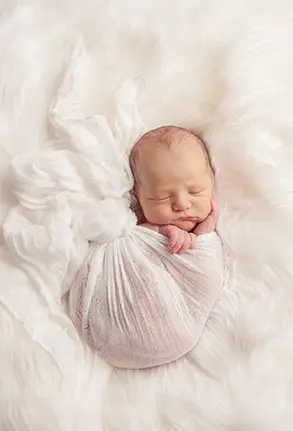
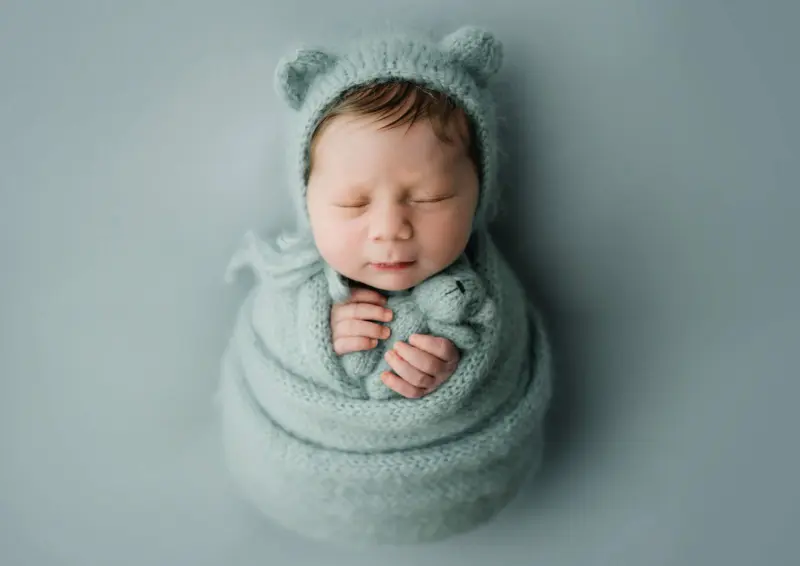
Knowing how to swaddle a baby for photos helps photographers create calm, consistent portraits, but the wrap must remain comfortable and easy to monitor. Work with proper newborn safety training and follow the family’s medical guidance; stop whenever the baby shows discomfort.
Prepare the wrap and room
Choose a soft, breathable newborn photography wrap with enough stretch for controlled layering. Inspect it for loose fibers, rough seams and decorations. Warm the room appropriately, wash your hands and place every needed layer within reach before positioning the baby.
Set the wrap flat and remove twists. For a decorative finish, prepare a second loose outer layer rather than relying on one tight fabric to create both support and texture.
Begin with a comfortable position
Keep the baby’s shoulders, hips and knees in a natural position. The legs should not be pulled straight or compressed together. Bring the arms gently toward the torso only if the baby settles comfortably that way.
Wrap below the shoulders so fabric cannot move over the face. The neck remains neutral, the airway visible and the chest unrestricted. You should be able to monitor breathing, temperature, color and circulation throughout the setup.
Build support with layers, not tightness
Use the first layer to contain the arms and torso gently. Bring the fabric across the body smoothly, then secure it without pulling against the hips. Add the outer layer for color or texture, checking that no bulky knot sits beneath the baby.
A photography wrap is for a supervised session, not unsupervised sleep. Never place a wrapped newborn on an unstable surface or leave the baby unattended while adjusting the set.
Photograph a simple wrapped sequence
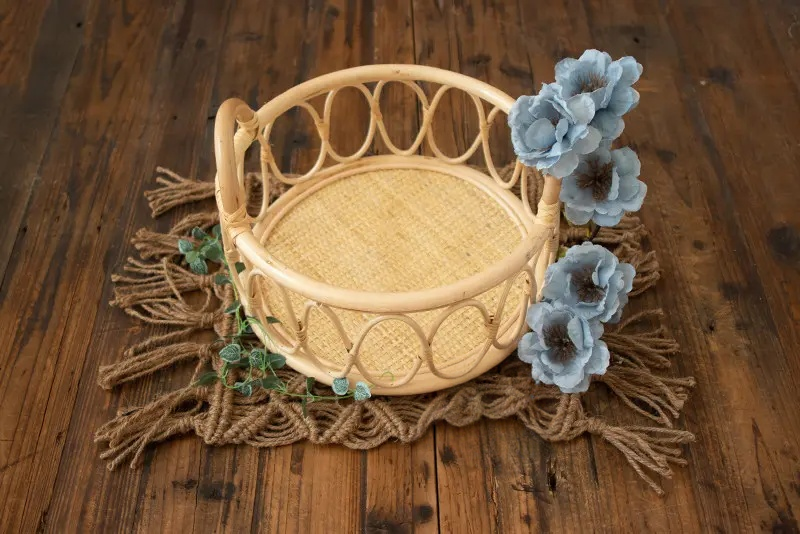
Start on a low, padded surface with a spotter close by. Capture a full wrapped portrait, a side angle, hands and facial details before moving to a supported bowl or basket. A single neutral wrap can work with several newborn posing props, giving the gallery variety without repeatedly disturbing the baby.
If the baby resists the wrap, pause and settle them. A calm loosely wrapped photograph is better than forcing a perfectly symmetrical result.
Swaddling safety checks
- Face and airway stay fully visible.
- Fabric remains below the shoulders.
- Chest movement is easy to observe.
- Hips and knees stay naturally flexed.
- Fingers and toes retain normal color and warmth.
- The baby is continuously supervised.
- The wrap is removed after the photographed sequence.
Practice the wrapping sequence on a photography training doll before a client session. This improves hand placement and speed without turning the live session into practice time.